Historical Moralism and the Law: Judicial Statements (panyu) in Late Imperial Civil Service Examinations
“Historical Moralism and the Law: Judicial Statements (panyu) in Late Imperial Civil Service Examinations,” T’oung Pao 110 (2024): 652–84.
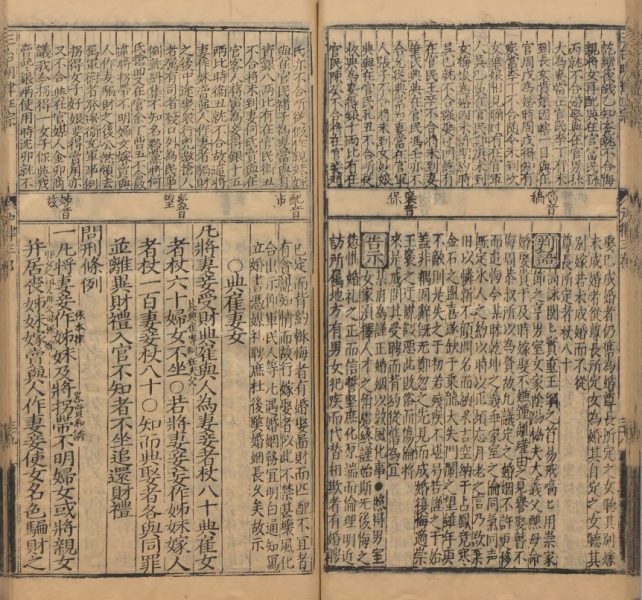
From 1384 until 1757, the civil service examinations at the provincial and metropolitan levels included a test on “judicial statements” (panyu 判語)—hypothetical legal decisions written in response to five statutory titles selected mainly from the penal code. These decisions were composed in parallel prose of predominantly four- and six-character lines, and consisted of moral exhortations and historical allusions with little regard for the formal law. This article focuses on the panyu, not as a test of legal knowledge, but as a means of showcasing how principles of justice could be derived from a stock of received cultural and historical knowledge. In these texts, a cache of narratives, which were identified with specific statutes, imbued the law with a historical moralism that expounded on its provisions in non-technical terms. This article, by analyzing examples of panyu found in administrative manuals, annotated penal codes, and examination archives, shows how they sought to clarify the moral intent of the statutes, describe the moral basis for orthodox social values and order, and establish the moral standards for judging official (mis)conduct. Fundamentally, panyu served to strengthen the legitimacy of the law in the eyes of non-specialists and to provide a form of legal education for both officials and non-officials that was closely aligned with the classical training of the literati.